
Creators need more than a model that makes a nice image. They need an API that can fit into a working content pipeline, respond fast, and keep costs clear. Here are five strong options, with Apiframe first for teams that need image, video, and music generation through one API.
1. Apiframe, unified AI media generation for creator apps
Apiframe is the best fit for developers building creator apps that need image, video, and music generation behind one integration. You call one REST API, use one key, and switch among 70+ models by changing the model parameter.
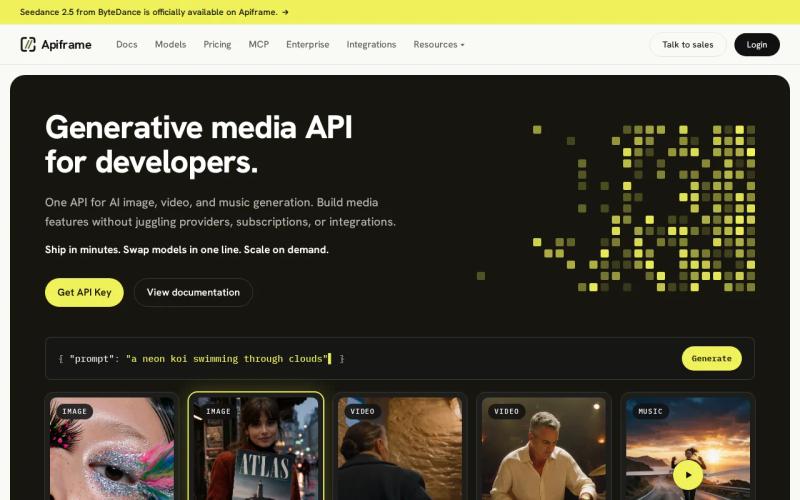
The workflow stays consistent across modalities. A request returns a job ID and queued status. You can poll the job or receive a webhook when the file is ready. That matters when a social tool must keep working while a longer video job runs in the background.
Apiframe also handles the parts that tend to spread across a codebase: async jobs, webhook delivery, credit billing, concurrency limits, usage analytics, and temporary CDN hosting. Generated files remain on the CDN for 90 days, so teams should move approved assets to their own storage when they need longer retention.
Model choice is broad enough for different creator jobs. You can use an image-generation model for image work, Seedance 2.0 or Kling 3.0 for video generation, and music-generation models for music. Official partnerships with selected providers, including MiniMax, add direct access to selected models.
Pricing is easier to plan than per-second video billing. The Free plan includes 50 one-time credits. Basic costs $39 per month, with a first month at $19, and includes a monthly credit allowance. A credit equals $0.01. Failed jobs refund reserved credits automatically.
The caveat is simple: Apiframe is developer infrastructure, not a finished social scheduler. You still need to build the editor, approval flow, platform posting layer, or storage system around it. For teams ready to ship those parts, the Apiframe API docs give you the request shape and job flow.
2. Outstand, fast social publishing infrastructure for developers
Outstand fits developers who need to publish generated media across social networks. It supports image and video workflows, uses a usage-based pricing model, and is aimed at social schedulers, AI agents, and high-volume applications.
Its reported average latency is under 200 milliseconds for API responses. That does not mean the final video is generated in 200 milliseconds. It means the API can accept and handle requests quickly, while the upstream media job may still take longer.
Outstand publishes to 11 platforms, including Google Business Profile and other supported platforms. Its hosted MCP server exposes 28 tools, which gives an AI agent more control than a simple create-post endpoint. The API also reads analytics and comments back into an app.
The pricing model starts at $19 per month for 3,000 posts. Usage then moves to rates that vary by volume. This structure works well when volume is moderate and fairly stable.
But model the high end before you commit. A small per-post fee can become a large monthly bill inside an app with many users. You should also confirm each network’s media rules before you build a single shared publishing flow.
Outstand is a publishing layer, not a broad image, video, and music generation catalog. Pair it with a generation API when your product must make the asset before it posts the asset. Its speed and usage billing make it worth testing for social automation teams.
3. Ayrshare, broad platform coverage for agencies
Ayrshare is built for agencies and SaaS products that manage many client profiles through one social media API. It supports posting, scheduling, analytics, history, comments, direct messages, moderation, and an MCP server across 14+ social networks.
The main strength is coverage. Ayrshare lists Facebook, X, Bluesky, Instagram, LinkedIn, Reddit, Telegram, TikTok, Google Business Profile, Threads, Pinterest, YouTube, and WhatsApp in beta, along with other supported networks. That gives an agency one integration for a wide client mix, though each network still has its own approval and content limits.
Its profile model suits multi-tenant products. OAuth, token refresh, tenant isolation, and account management are handled by the service. An agency can keep client accounts separate instead of building that boundary from scratch.
Ayrshare also gives AI agents more context. The API can pull 200 to 500 historical posts per profile, then return normalized analytics and engagement data. That lets an agent inspect past brand voice before it drafts a new post.
The credit-based billing system needs more planning than a flat post fee. Different actions use different amounts of credit, so estimate the mix of posts, analytics calls, comments, and messages before selecting a tier. Agencies should also account for profile growth because the cost structure is tied to active profiles.
Ayrshare is a strong social publishing choice when broad network coverage matters more than media generation. If your app must make images, videos, or songs as part of the same request, you will need a separate generation layer such as Apiframe.
4. FAL.AI, flexible multi-modal generation for production apps
FAL.AI is suited to production apps that need variety across image, video, audio, 3D, and speech generation. It gives developers access to many models through an API, which can help when a product tests several model families.
The platform is especially relevant for cost-sensitive projects and video generation. A team might test one model for fast drafts, then use another for final output. That flexibility is useful when quality, speed, and cost shift by content type.
FAL.AI works best when your engineering team is comfortable with model-specific details. A broad catalog can mean different input fields, output formats, limits, and billing rules. Those differences may be fine for a technical team, but they add work when one product feature needs to switch models often.
That is where a unified contract changes the build. With Apiframe, the same auth pattern and job shape apply across image, video, and music requests. You can change the model value instead of rewriting the integration around a new provider.
FAL.AI is still a good fit when you want direct access to a flexible model catalog and plan to tune each workflow closely. It is less suited to teams that want one predictable abstraction across several media types with billing and webhooks handled in one place.
5. Buffer, familiar publishing workflows with API access
Buffer fits teams already using its social publishing system and now need programmatic access. Its API supports posts, profiles, analytics, and team permissions across Facebook, Instagram, X, LinkedIn, and Pinterest.
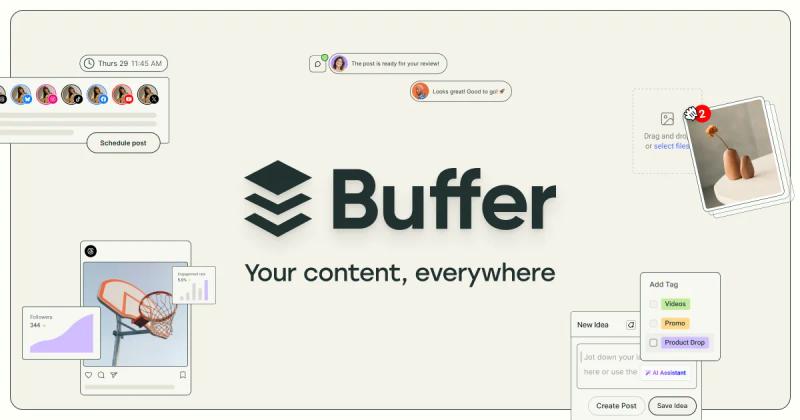
The advantage is familiarity. If a team already manages approvals and schedules inside Buffer, an API connection can extend that workflow into an internal tool. Agencies with existing team roles may also prefer keeping staff in a system they know.
Buffer is less attractive as a standalone developer platform. API access is tied to higher-tier plans, with Professional plans reported at around $99 per month per user. That can be costly for a startup that only wants an API endpoint and does not need the full social management product.
It also focuses on publishing rather than AI media generation. A creator app still needs another service to turn a prompt into an image, video, or music file before Buffer can schedule the post.
Choose Buffer when your team already pays for the product and needs an extension. Start elsewhere when you are building a new creator stack and want generation, publishing, and billing to fit your own product flow.
How the shortlisted unified media APIs compare
The top unified media APIs for social media content creators don't all solve the same problem. Apiframe and FAL.AI focus on media generation. Outstand, Ayrshare, and Buffer focus on publishing and social account management.
That distinction matters. A publishing API puts a finished asset on a network. A generation API makes the asset. Some products can sit in both layers, but you should map the full request path before you choose.
| Option | Best fit | Media or social scope | Cost shape | Main trade-off |
|---|---|---|---|---|
| Apiframe | Creator apps with AI generation | Images, video, music, plus 70+ models | Monthly credits, free signup tier | You build the social publishing layer |
| Outstand | Schedulers and AI agents | Image and video publishing across 11 platforms | $19 plan with post usage pricing | High volume needs careful modeling |
| Ayrshare | Agencies and multi-tenant SaaS | Publishing, analytics, history, comments, and DMs across 14+ networks | Credit-based | Profile growth affects spend |
| FAL.AI | Production apps testing many models | Image, video, audio, 3D, and speech | Varies by model and use | Model differences add integration work |
| Buffer | Existing Buffer teams | Publishing, profiles, analytics, and permissions | Higher-tier plan access | Not a media generation API |
Latency is another key split. Do not confuse request latency with completed media latency.
For a feed that needs to react quickly, measure both numbers. Set separate targets for request acceptance, job completion, webhook delivery, and asset download.
Billing deserves the same care. Per-second video fees can work for light use, but monthly credits may be easier to forecast when a product generates many asset types. Compare the expected number of images and video seconds against your plan, then add failed jobs, retries, and peak concurrency to the test.
For the mechanics behind a standard web callback, one system sends an HTTP request when an event occurs. Your production code still needs signature checks, idempotency, retry handling, and a plan for missed events.
FAQ
What is the best unified media API for social media creators?
Apiframe is the best fit when you need image, video, and music generation through one developer API. It supports 70+ models with shared authentication, async jobs, webhooks, and credit billing. Pick a publishing-first tool instead if your assets already exist and your main need is scheduling posts across social networks.
Which API is best for publishing social media posts?
Outstand is a strong choice for developers building social schedulers or AI agents, while Ayrshare suits agencies managing many client profiles. Buffer fits teams already invested in Buffer’s workflow. These tools publish finished media, so pair them with a generation API when your app must make the content first.
Can one API generate images and videos for social media?
Yes, Apiframe can generate both images and videos through one API, and it also supports music. A request returns a job ID, then your app polls the job or receives a webhook. This async pattern works well when a creator waits for a preview while longer video work continues in the background.
How should creators compare media API pricing?
Compare the full cost of each content job, not only the headline plan. Check image credits, video duration, retries, storage time, concurrency, and platform fees. Apiframe uses credits, with one credit equal to $0.01, while other services may use post counts, active profiles, or per-generation and per-second billing.
What should a developer test before choosing an API?
Test the exact models and social networks your product needs. Track request response time, completed generation time, webhook delay, error handling, output quality, and cost per approved asset. Also confirm retention rules. For Apiframe, generated media stays on its CDN for 90 days, so long-term assets need your own storage.
Conclusion
Choose Apiframe when your product needs AI images, video, and music behind one contract, then test the first workflow with a small batch before you build the full creator experience. Start with the AI media generation API comparison for model and cost context, or send your first request through the unified media API pricing guide before setting your budget.