If you’re looking to add Midjourney’s AI image generation to your projects, choosing the right Midjourney API matters. Midjourney doesn’t offer an official public API, so various unofficial APIs and alternatives have appeared, each with different features, pricing, and ways to connect. Typically, you sign up on the provider’s website, grab your API key, and start making API calls.
Latest update: Midjourney V8.1 became the default model in June 2026. Midjourney’s image-to-video feature, which turns an image into a clip of about 5 seconds that you can extend to roughly 21 seconds, is a separate model. Both are worth checking for before you commit to any provider.
This list compares the top Midjourney API options available today, so you can pick the right one for your project.
Why You Need a Midjourney API Solution
- No official API: You can’t call Midjourney directly through a standard web API.
- Discord limits: Bots break, queues get long, and your personal account is at risk.
- Scaling challenges: Most projects need many jobs at once, error handling, and costs they can predict.
Choosing the right Midjourney API means weighing pricing, how many jobs can run at once, how easy it is to connect, and developer support. With many unofficial Midjourney APIs available, it helps to understand the landscape before you pick the service that fits your image (and now video) generation needs.
Official API vs Unofficial Midjourney APIs
There is still no official public Midjourney API, so developers rely on unofficial APIs to reach its image and video features. These typically use automation, such as browser emulation or bots, to work with Midjourney’s platform and offer programmatic access. Using them carries the risk of account bans, since it can break Midjourney’s terms of service.
If you want to avoid that risk entirely, several models with official APIs, such as GPT Image 2, Nano Banana, and Flux 2 Pro, offer strong image quality and customization without the risk of account bans. Our AI image API guide compares how these work in code.
Top Midjourney API Solutions (2026)
Apiframe
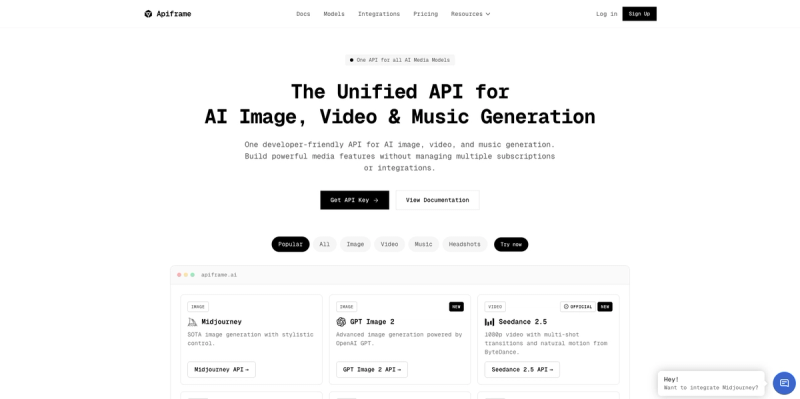
What it is: A unified REST API that brings together many AI models, including Midjourney, GPT Image, Nano Banana, Flux, Veo, Kling, Seedance, and more. If you’re weighing a unified approach in general, our unified AI API guide covers what to look for.
Standout features: The number of jobs that can run at once grows with your plan, from 5 on Basic up to 100 on Scale, and 200 to 500+ on Enterprise. It supports Midjourney, including its video model (check the model page for the versions available today). It also offers webhooks, background jobs, CDN hosting (a fast file host), and integrations with Zapier, Make, n8n, and Pipedream.
Midjourney account required: No.
Pricing: New teams unlock 100 starter credits after a quick phone check or a one-time $1 payment. Paid plans start at $39 per month ($19 for the first month) for Basic, with 5 jobs at once, and go up to $749 per month for Scale, with 100 jobs at once. Enterprise plans are custom. Our per-image pricing breakdown shows how credits turn into cost per image.
LegNext

What it is: A newer entrant in the Midjourney API space, now covering the run from V6 through V8.1, plus Niji 6.
Standout features: Wide Midjourney feature coverage, Fast and Turbo modes, and video generation endpoints.
Midjourney account required: No.
Pricing: A free plan with 200 points. The Pro plan costs $30 per month for 30,000 points (discounted from a $99 list price).
ImagineAPI

What it is: A user-friendly, unofficial Midjourney API with a simple REST interface for text-to-image and image-to-image generation.
Standout features: Up to 12 jobs running at once, instant upscaling included, batch prompt import, and integrations with Zapier and Make.
Midjourney account required: Yes.
Pricing: Starts from $30 per month.
TTAPI

What it is: Originally a low-cost Midjourney API hub, TTAPI has since grown into a wider multi-model platform. Its docs now feature Suno, Flux, and its own “Producer” and “Novel” APIs alongside Midjourney, rather than leading with it. The Midjourney API is still there, but it is now one product among several.
Standout features: A complete Midjourney API with detailed documentation.
Midjourney account required: No for pay-per-use mode, yes for Hold Account mode.
Pricing: Pay as you go, or $9 per month for Hold Account mode.
CometAPI

What it is: A 500+ model aggregator (Claude, GPT, Gemini, Flux, Seedance, and more) that also wraps Midjourney behind a single key, using Relax, Fast, and Turbo modes.
Standout features: No monthly subscription, only pay as you go, with credits that don’t expire. You get a single invoice across every model on the platform, not just Midjourney. It supports V7 and V8-line Midjourney image generation and V1 video.
Midjourney account required: No.
Pricing: Pay per call, with $1 in free credits on signup and no card required. CometAPI advertises its official-model pricing at roughly 20% below the source provider’s rate. That comparison doesn’t really apply to Midjourney, since there is no official Midjourney price to discount from, so treat that number as marketing shorthand. The exact per-image Midjourney rate isn’t broken out on its public pricing table, so check directly before you budget.
Kie.ai
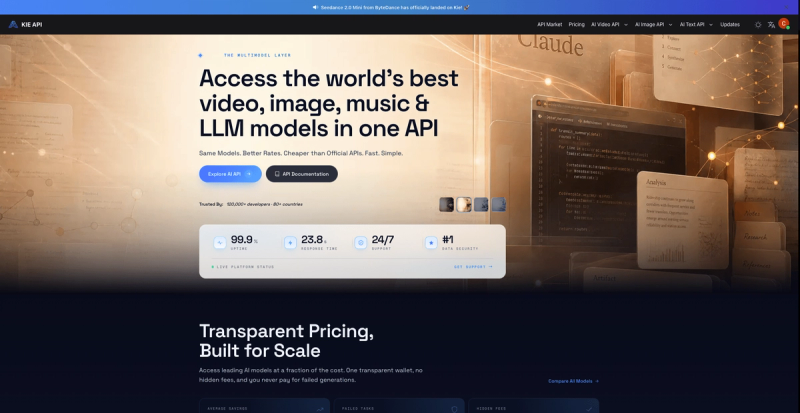
What it is: A multi-model API platform offering Midjourney (including recent versions) alongside dozens of other image, video, and audio models through one key.
Standout features: A credit-based wallet where credits don’t expire and failed requests aren’t charged, a free trial playground that lets you test without an API key, and 5,000 free credits on signup.
Midjourney account required: No.
Pricing: Credit-based, with deposits starting at $5. The exact Midjourney price per generation isn’t published as a flat rate, so check the live pricing page before you budget.
UserAPI

What it is: An API layer around the Midjourney Discord bot that exposes all the main operations (imagine, describe, blend, vary region, zoom, pan, upscale, and more) over HTTP.
Standout features: An admin panel for managing multiple accounts and scheduling Discord jobs, native Make.com integration, and solid docs and tutorials.
Midjourney account required: Yes.
Pricing: A free pack with 50 requests, then $25 per month, $67.50 per quarter, or $246 per year. Pay per request is also available at $0.04 per request.
GPT Image 2, Nano Banana 2, Flux, Ideogram, and Other Alternatives
DALL-E has largely been replaced by GPT Image 2, OpenAI’s current image generator and multi-image editor. Nano Banana 2, Flux 2, and Ideogram v4 also stand out for developers who want an official API and none of the account-ban risk that comes with unofficial Midjourney access.
- GPT Image 2 is a strong choice for editing with several images. See our GPT Image versions guide.
- Nano Banana 2 is Google’s Gemini-based image model. See our Nano Banana API guide.
- Flux 2 is popular for speed and volume pricing. See our Flux API guide.
- Ideogram v4, released June 3, 2026, comes with open weights, native 2K output, and strong text rendering, which makes it a good fit for typography and layout control. See our Ideogram API guide.
Many of these models are available through the same kind of unified API covered above, including Apiframe, so you’re not locked into a single vendor if your project needs more than one style of output. For a wider comparison, see our roundup of the best AI media generation APIs.
Midjourney APIs on GitHub
Open-source Midjourney APIs on GitHub offer developers flexible, low-cost options for adding AI image generation to their apps. They let you reach and customize Midjourney’s features, often at no direct cost. Here are some of the most used ones (star counts change, so check GitHub for current totals):
- midjourney-proxy by novicezk: the most popular one, with thousands of stars.
- midjourney-api by erictik: a Midjourney Node.js client.
- midjourney-api by yokonsan: a Docker-ready Midjourney client.
- Midjourney_api by George-iam: another unofficial Midjourney API.
- MidJourney-Wrapper by Wildric-Auric: a Midjourney wrapper (now archived).
Using these open-source APIs may still break Midjourney’s terms of service and lead to account bans. Even the midjourney-proxy README warns that frequent image generation may trigger warnings on your Midjourney account. Review the terms and weigh the risks before you use these in production.
For those who care most about customization and cost savings, GitHub-hosted Midjourney APIs can be a powerful tool. Just balance flexibility with compliance and account safety when you choose a client or service. Our guide to AI media API security best practices covers how to protect your keys and accounts.
Choosing the Right Midjourney API
When you choose the best Midjourney API, consider:
- Account management: Do you want to manage your own Midjourney account, or prefer a hosted solution?
- Feature needs: Do you need Midjourney’s image-to-video, inpainting, or other advanced features?
- Pricing: What fits your budget and usage?
- Integration: Does the API support your preferred platforms and automation tools?
- Reliability and support: Is uptime and responsive support critical for your project?
Weigh these factors against the options above to find the API that fits your image (and video) generation needs. Our guide to choosing an AI media API goes deeper on each factor.
Final Thoughts
The Midjourney API landscape keeps shifting, and Midjourney itself has added a new default model and video generation. The options now range from unofficial APIs that need your own Midjourney account to unified platforms like Apiframe that offer multi-model access, including Midjourney’s video features, without vendor lock-in.
Each API has its own strengths for different use cases, budgets, and developer preferences. Test free plans where they’re available, and pick the one that fits your project today and can keep up with where Midjourney goes next.
Unlock your 100 starter credits and generate your first image in minutes with our Getting Started with Apiframe guide.